How to Improve Website Visibility in Google and AI Search: A 30-Day Plan
Website Visibility & Organic Search · Part 2 of 3
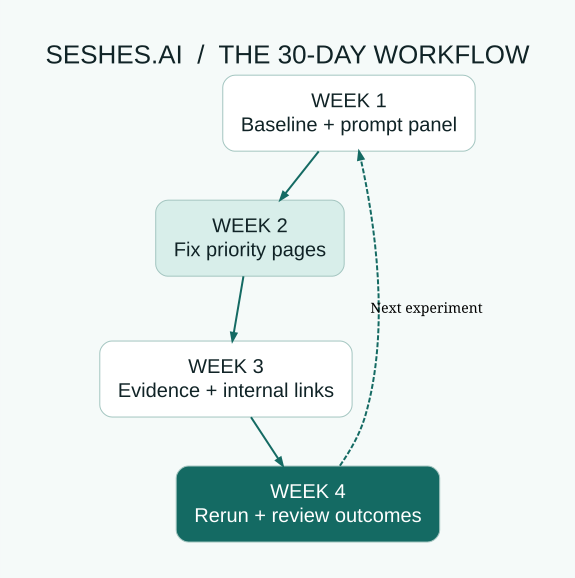
To improve website visibility in Google and AI search, make important pages accessible, answer buyer questions clearly, support claims with evidence, and measure repeated observations alongside qualified traffic. Start with a few pages that matter to your business. Use the next 30 days to establish a baseline and run a focused improvement cycle.
This is a work plan, not a promise of rankings or citations within a month. Discovery and indexing take time; generated answers can change without any change to your website. Your first month should produce a better page, a reliable measurement habit, and a clear next decision.
What is the best starting point for SEO and AEO?
Choose one buyer problem and the pages that already address it. Before producing another article, review the existing URLs. A product page, comparison page, or useful tutorial may need a better answer rather than a competing new page. Part 1 explains how to diagnose visibility and traffic before choosing an intervention.
Google’s AI features guidance says the same foundational SEO practices apply to AI Overviews and AI Mode. There is no special schema or AI text file required for inclusion. Supporting pages must be indexed and eligible for search snippets; eligibility does not guarantee selection.
Use answer clarity to help the reader: state the answer, explain the conditions, show the evidence, and make the next action obvious. Treat this structure as an editorial practice to test, rather than a guaranteed citation formula.
Week 1: Establish a baseline and choose your questions
Days 1–7: choose a small set of valuable pages and a stable panel of buyer questions. Export comparable completed periods from Search Console. Record each page’s relevant queries, clicks, impressions, CTR, and average position. Add organic visits and meaningful conversion events from your analytics.
Start with a manageable pilot, such as 20–30 questions across your main buyer problems. That is a workload suggestion, not a statistically sufficient sample for every category. Expand the panel as you learn which topics matter, and record when its composition changes.
| Intent | Example question | Likely page to improve |
|---|---|---|
| Understand the problem | Why is my website traffic falling when impressions are rising? | Diagnostic guide |
| Choose an approach | How do I improve website visibility in Google and AI answers? | Practical workflow |
| Compare tools | Which AI visibility tool helps marketers choose what to fix? | Transparent comparison |
| Evaluate the product | Can this platform show which pages AI engines cite? | Product capability page |
For each run, record engine, exact prompt, date, language, market, and whether web search was enabled where observable. Preserve failed runs and log how you handle them in the denominator. Branded prompts and unbranded category prompts belong in separate groups.
Week 2: Improve the pages most likely to help a buyer
Days 8–14: fix access problems and make each priority page useful on its own. Check status codes, canonical destinations, indexing controls, and internal discoverability. Confirm the core answer and product facts are available as readable text.
- Give the page one clear job. Match the title and main heading to the problem it solves. Use section headings that reflect genuine follow-up questions.
- Answer before expanding. Put a short, self-contained answer near the start of the relevant section. Then explain exceptions, steps, and examples.
- Make claims specific. Identify who a product is for, what it does, and any important limits. Remove unsupported superlatives and obsolete specifications.
- Offer a reason to continue. Include a useful worksheet, real example, decision table, or product walkthrough that a short generated summary cannot fully deliver.
- Check the next action. Make demo and signup links easy to find and verify that forms work on mobile.
Google’s helpful content guidance emphasizes originality, accuracy, and clear authorship. Apply that standard to your evidence and byline. Do not imply first-hand testing when the page is based on desk research.
Why this work should go beyond chasing impressions
In Ahrefs’ September 16, 2026 France study, the highly exposed group’s median CTR moved from 2.29% before the AI Overviews launch to 1.76% afterward. The panel contained 963 domains; high exposure meant more than 20% of queries triggered an AI Overview. The comparison used 28 days before July 22 and nine days after.
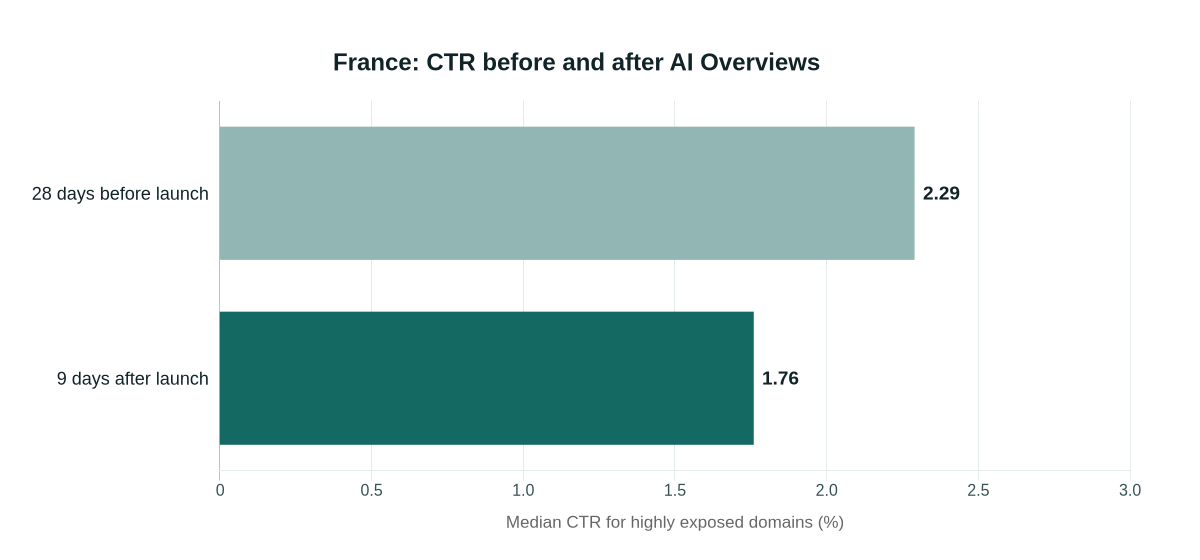
The practical implication is to evaluate what the page contributes after it is discovered. A page that helps a buyer compare options, validate a decision, or use a tool can offer a useful next step beyond a short answer. Measure whether that usefulness produces qualified action; do not assume that adding a table or FAQ will increase clicks.
Week 3: Add evidence, useful visuals, and internal links
Days 15–21: add information that helps the buyer make a better decision. A documented example, a clearly sourced chart, or a product walkthrough is more useful than another unsupported claim that your solution is best.
If you have original research, publish the sample, collection period, definitions, exclusions, and limitations alongside the result. If you use someone else’s study, link to the original publication and explain its scope. Do not combine incompatible percentages into a supposed market trend.
Use a visual only when it clarifies something: a workflow for a process, a bar chart for comparable data, or a screenshot for a real product feature. Provide useful alternative text and a nearby explanation. Keep key numbers in readable page text or a table so the image is not the only source of information.
Add descriptive links from relevant supporting pages and link back to the deeper product or concept page. Each URL should have a distinct role. If two pages answer the same question for the same audience, consider improving the stronger page before adding a third.
For a Seshes.ai workflow, pair cited-source analysis with the report walkthrough. Inspect the question and source behind an observation before deciding which content change to make.
Week 4: Repeat the measurement and choose the next experiment
Days 22–30: rerun the same question panel, annotate your changes, and compare like-for-like outcomes. Review inclusion by engine and question group. Check whether cited URLs and product descriptions changed. Keep business outcomes separate from visibility metrics.
| Measure | How to review it | Decision it supports |
|---|---|---|
| Relevant organic clicks | Same page and query groups; completed periods | Does the result still bring useful visitors? |
| Brand coverage | Answers naming the brand ÷ valid sampled answers; defined panel | Is inclusion changing for these questions? |
| Citation coverage | Answers citing the target domain or URL ÷ valid sampled answers | Which sources or pages need investigation? |
| Qualified actions | Demo requests or other defined events by landing page and channel | Are visitors taking the intended next step? |
If there are few observations or conversions, report the counts and keep collecting. If visibility improves but business outcomes do not, review intent and the on-page offer. If only one engine changes, investigate that engine’s answers rather than declaring a market-wide win.
Keep an unchanged comparison group of relevant pages where feasible. An improvement after publication is still an association: demand, competitors, engine updates, and seasonal effects can move at the same time.
Frequently asked questions
How long does it take to improve AI visibility?
There is no fixed deadline. The 30-day plan organizes work and establishes repeated measurement; it does not guarantee discovery, indexing, mentions, or citations within that window.
Should every page have an FAQ?
No. Use FAQs when they answer real buyer questions the page has not already resolved. Keep the answers visible and useful; adding FAQ markup does not promise rich results or AI inclusion.
Should I create a page for every prompt?
No. Group questions with the same intent on a strong page. Create a new URL when the reader needs a genuinely different answer, tool, comparison, or use case.
Turn the diagnosis into your next Sesh
Bring one priority page, your buyer questions, and two competitors. Book a Seshes.ai demo to see the workflow with your team, or sign up and start tracking your brand. Use the first report to choose one concrete content improvement.
Next: compare AI visibility tools and run a fair pilot. Revisit the visibility-versus-traffic diagnosis when your metrics move in different directions.
Research checked October 9, 2026. Prepared with AI assistance using linked primary documentation and original research. The 30-day workflow and example prompts are editorial recommendations, not measured results.