
Why Website Visibility Can Rise While Organic Traffic Falls
Website Visibility & Organic Search · Part 1 of 3
Your website can become more visible without earning more organic traffic. Search impressions, AI brand mentions, website citations, and visits measure different events. When clicks fall, compare queries, rankings, click-through rate, and conversion outcomes before blaming AI search or rewriting your entire site.
The marketer’s job is to find where discovery stops turning into useful action. A page that answers a quick question needs a different response from a product page that attracts qualified buyers but loses them before signup. This guide gives you a way to separate those problems.
What does website visibility mean in Google and AI search?
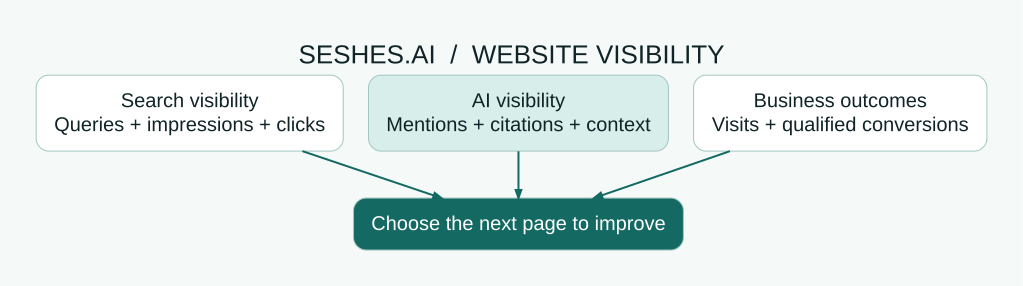
Website visibility is the opportunity for people to encounter your pages or brand. Organic search traffic is the visits that follow unpaid search clicks. AI visibility describes inclusion in generated answers; it can involve a brand mention, a linked citation, or a product recommendation.
SEO helps people and search systems find useful pages. Answer engine optimization (AEO) focuses on making answers clear and useful in answer-led discovery. Generative engine optimization (GEO) is commonly used for improving discoverability in generated responses. These labels overlap; they do not require three separate content calendars.
| Signal | What it answers | What it cannot establish |
|---|---|---|
| Search impressions | Did a search result appear? | Whether someone read or visited the page |
| Organic clicks and CTR | Did the result earn a click? | Whether that visit became a qualified lead |
| Brand mention | Did the answer name the brand? | Whether the brand’s own website was cited |
| Website citation | Did the answer reference a URL? | Whether the user clicked that reference |
| Conversions | Did a tracked visit produce a defined action? | Every earlier influence on the buyer |
What does current research say about AI answers and clicks?
A Pew Research Center study published July 22, 2025 analyzed browsing data from 900 U.S. adults in March 2025. Traditional search result clicks occurred on 8% of visits with an AI summary, compared with 15% without one. Clicks on summary sources occurred on 1% of visits with a summary.
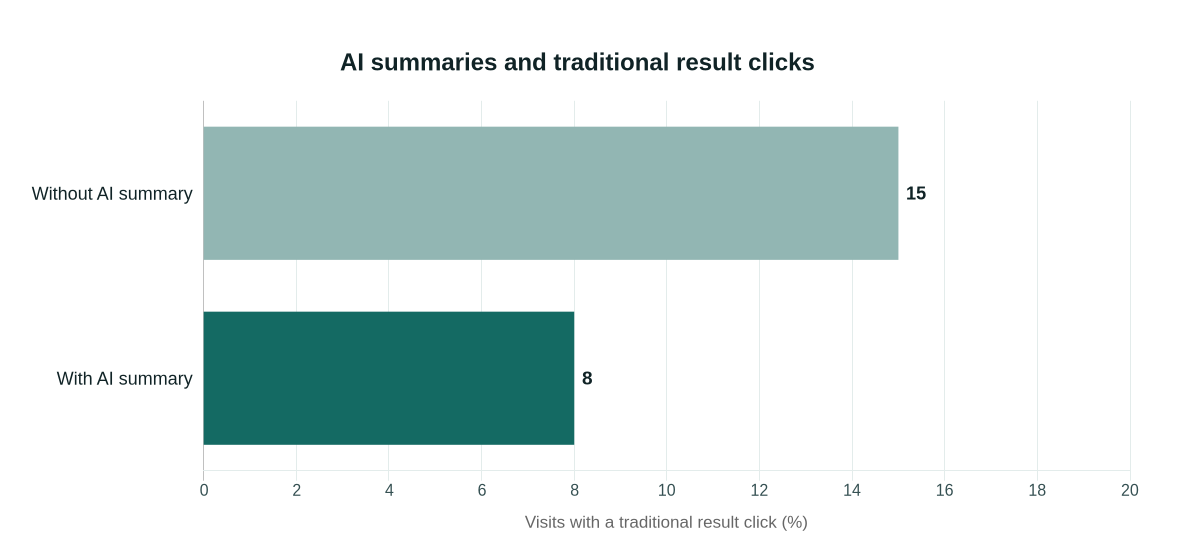
This is an observed difference between groups, not a controlled forecast for your website. The older study provides context, not a current universal click benchmark. Query intent, device, audience, and the results shown can all change what happens on your pages.
More recent evidence points to continued pressure on clicks in some markets. Ahrefs’ September 2026 France analysis observed a 23.1% median CTR decline among highly exposed domains around the AI Overviews launch. The result comes from a short before-and-after window; it should prompt investigation, not an assumption that your site will lose the same percentage.
Why can impressions increase while organic clicks decrease?
CTR falls whenever clicks grow more slowly than impressions, or decline while impressions rise. That arithmetic identifies the pattern, not its cause. You may be appearing for more broad queries, losing attractive positions, competing with new result features, or offering a title that no longer matches what the buyer wants.
Start with comparable completed periods. Keep country, device, search type, and page filters consistent. Then split branded from non-branded queries and separate informational pages from commercial pages. Sitewide averages can hide one growing query group and another shrinking one.
A five-check diagnosis for hands-on marketers
- Find the affected pages. Compare clicks, impressions, CTR, and average position by landing page. Check tracking or reporting changes before interpreting a sudden break.
- Inspect the same query groups. A lower average position or a new mix of low-intent queries can explain falling CTR. Treat average position as an aggregate rather than a fixed rank.
- Look at the current results. Record ads, AI answers, snippets, shopping results, and competing titles for priority queries. One manual search is a snapshot; repeat important checks.
- Compare traffic quality. Review organic landing-page visits and meaningful events such as demo requests. Fewer low-intent visits may coexist with stable qualified conversions.
- Check AI inclusion independently. Test relevant buyer questions across the engines you care about. Store the answer, date, brand mention, cited URL, and accuracy of the description.
Google says AI Overviews and AI Mode traffic is included in the Search Console Web performance report. Do not label a change in total Web clicks as an isolated AI trend. See Google’s AI features documentation for the reporting scope.
How should you measure AI visibility alongside organic traffic?
Use a fixed set of buyer questions and report AI inclusion alongside search and business outcomes. Keep the prompt panel stable enough to compare observations. Tag questions by problem, use case, comparison, and purchase stage. Branded questions should be reported separately because they already name your business.
Ahrefs’ October 6, 2026 measurement guide emphasizes that tracked referrals capture only part of AI influence. Our practical recommendation is to report observed AI referrals and conversions, customer-reported discovery, and repeated prompt observations as separate evidence. A rise in direct or branded traffic alone does not establish AI causation.
In Seshes.ai, use citation analysis to inspect referenced URLs and the score glossary to understand what each metric represents. GA4 + GSC Hybrid Insights provides a way to compare AI discovery with page performance. A proprietary score is a diagnostic signal, not a substitute for visits or conversions.
What should you change first?
Choose the smallest useful intervention supported by the diagnosis. If search visibility fell, investigate indexing, query relevance, and page quality. If visibility is stable but CTR fell, examine the result layout and whether the title promises a useful next step. If visitors arrive but do not convert, improve the page’s fit, evidence, or call to action.
When an AI answer misstates your product, check the cited source and correct the underlying facts where you control them. When a competitor is named for a specific use case, evaluate whether your site explains that use case clearly and provides evidence. Publishing more generic articles is unlikely to resolve either problem.
Frequently asked questions
Does AEO replace SEO?
No. AEO adds an answer-discovery perspective to an existing search strategy. Maintain useful, accessible pages while measuring whether your brand and content appear in AI answers.
Does an AI citation count as organic traffic?
No. A citation is a reference in an answer. A visit happens only if someone reaches the website. Its analytics classification depends on the platform, link, referrer, and tracking setup.
Can I prove AI caused a traffic decline from Search Console alone?
No. You need query-level comparisons, result observations, and checks for other changes. Search Console patterns can support a hypothesis but do not isolate every cause.
Turn the diagnosis into your next Sesh
Bring one priority page, your buyer questions, and two competitors. Book a Seshes.ai demo to see the workflow with your team, or sign up and start tracking your brand. Use the first report to choose one concrete content improvement.
Continue with the 30-day SEO and AEO improvement plan, then use our AI visibility tools comparison to select a measurement workflow.
Research checked October 9, 2026. Prepared with AI assistance using the linked primary documentation and original research. Study results are attributed to their publishers; recommendations are Seshes.ai editorial guidance.
One Comment
Comments are closed.