Google’s Updated AI Content Guidance: A Publishing Checklist for Marketers
Google’s updated AI content guidance calls for accurate, useful content and manual review before publication. For marketers, the practical response is a documented publishing check covering facts, original value, source quality, authorship, metadata, and images. Using AI to help draft a page does not remove editorial responsibility.
A polished paragraph can still contain the wrong date, an unsupported product claim, or a citation that does not support the sentence. Review should happen at the level of individual claims and reader tasks, not just grammar.
What changed in Google’s guidance?
Google’s generative AI content guidance, updated October 1, 2026, emphasizes reviewing generated material for factual reliability. The review extends to titles, descriptions, structured data, and image alternatives. Google also cautions against mass-producing pages that contribute little useful value.
The guidance refers readers to Search Quality Raters guidelines, while explaining that rater assessments do not directly set rankings. It does not announce a blanket ban on AI-assisted writing or guarantee rankings for human-reviewed pages.
A practical review process before publication
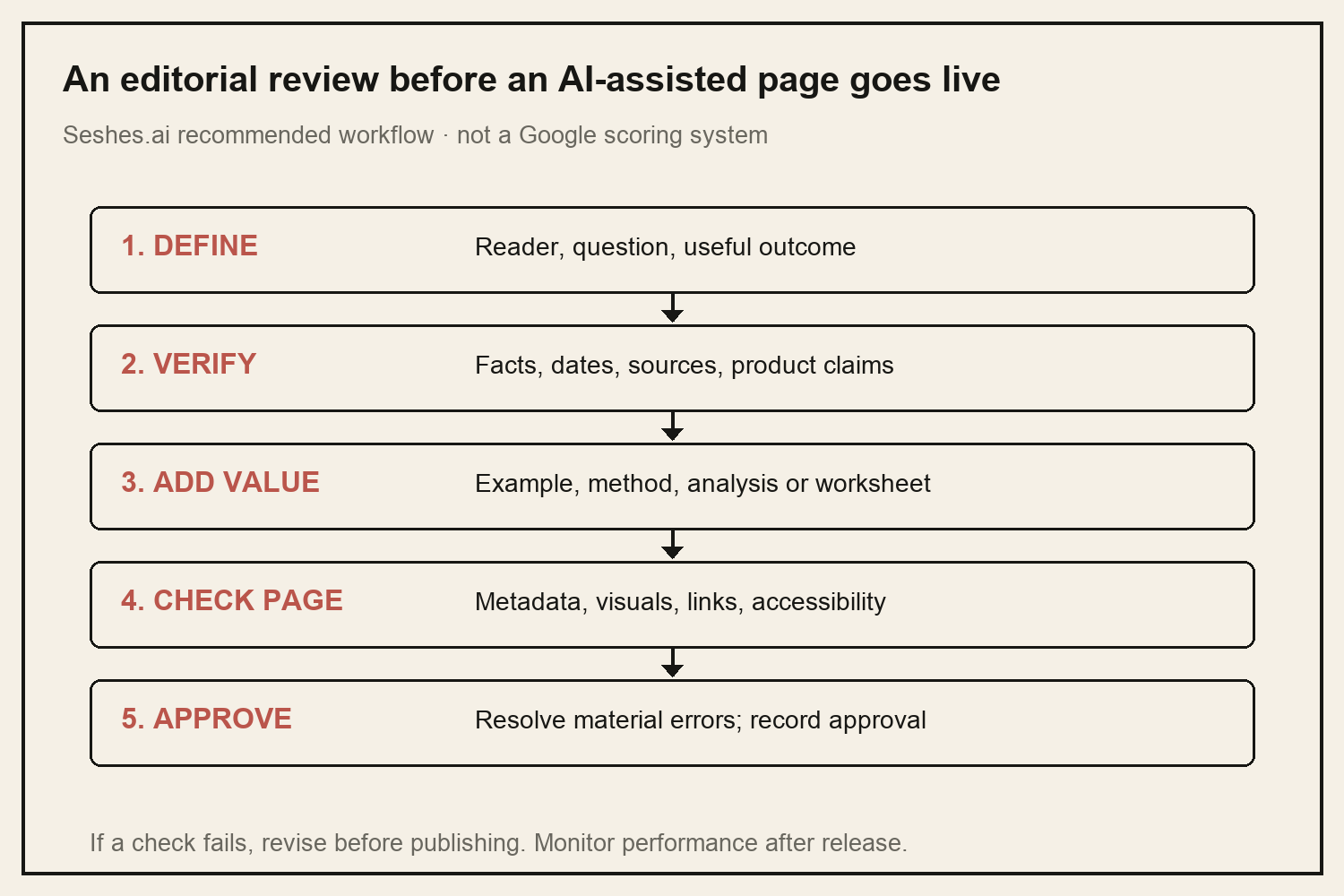
Use the workflow below as an editorial control. It is a Seshes recommendation, not a Google scoring system. Assign an owner to each check and retain the evidence for consequential claims. If a check fails, fix the page before treating it as ready.
| Check | Evidence to inspect | Ready when |
|---|---|---|
| Reader value | The question, intended reader, and useful result | The page helps complete a specific task |
| Claim accuracy | Original sources, dates, sample scope, product documentation | Important claims are verified or clearly qualified |
| Original contribution | Examples, method, analysis, worksheet, or firsthand material | The page adds useful substance beyond a paraphrase |
| Identity and transparency | Author attribution and explanation of assistance where useful | No invented expert, customer quote, or test result appears |
| Page and image accuracy | Title, description, alt text, chart labels, visible content | Every description represents what readers actually see |
| Links and accessibility | Sources, internal links, readable text and images | The reader can inspect evidence and continue the task |
| Final approval | Recorded issues and accountable reviewer | Material errors are resolved and approval is documented |
Check claims against original evidence
Open every source used to support a consequential factual statement. Confirm that it actually supports the claim, and that the publication date is not being confused with the event date. For research, record the sample, geography, period, and metric. A percentage from a US desktop study should not become a claim about all buyers worldwide.
Separate a source’s findings from your recommendation. “This study observed a change” and “we suggest testing this workflow” are different statements. If you cannot verify a figure, remove it or explain the uncertainty instead of creating a plausible substitute.
Add something a marketer can use
Before expanding a draft, ask what the reader can do after reading it. A reusable worksheet, a documented example, or a clear decision rule can be more helpful than additional background paragraphs. Include realistic limitations: who the advice fits, what information it requires, and what outcome it cannot promise.
For example, an article about brand representation can include an AI brand visibility audit with a claim log and next-action field. An article about discovery can include a branded and non-branded question matrix. These tools add a practical purpose without pretending that hypothetical examples are customer evidence.
Review the whole page, including metadata and visuals
Read the search title and description after the body is final. They should accurately describe the page rather than promise guaranteed citations or traffic gains. Use a clear heading hierarchy, descriptive links, and image alternatives that explain the visual’s purpose. Provide text or a table alongside charts so the information remains usable without the image.
Check schema against the visible content and let the site’s existing SEO system handle appropriate article markup. Avoid adding a second competing schema block or marking up fabricated ratings. A checklist is useful to readers even when it does not receive a special search appearance.
Keep the SEO foundations while improving answer clarity
Google’s AI features documentation says existing SEO fundamentals remain relevant to AI Overviews and AI Mode. It does not require special AI schema or a new AI text file. Eligibility for supporting links depends on indexing and snippet eligibility, and inclusion is not guaranteed.
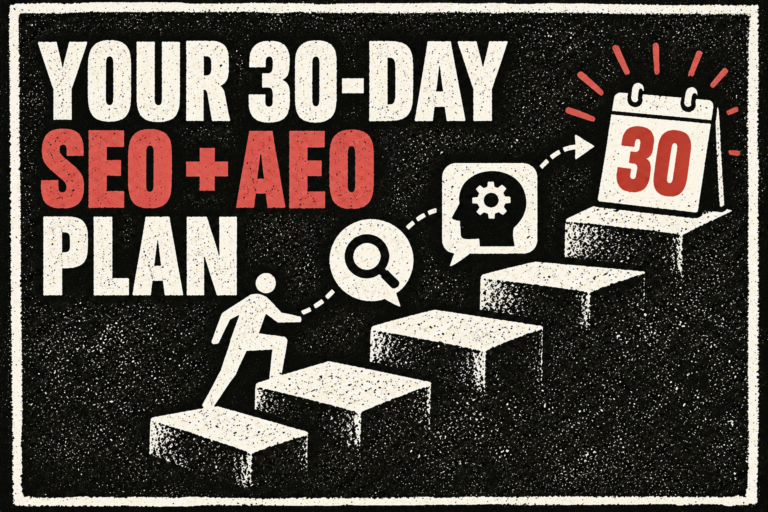
For your own page review, check that important explanations are available in text, the page is discoverable through relevant internal links, and the main answer is easy to find. Work these checks into the 30-day SEO and AEO plan. Clear structure helps readers understand your work; it should not be presented as a guaranteed citation technique.
Check what happens after publishing
Record the release date and the meaningful changes you made. Review search performance and sampled AI answers separately. If an AI answer repeats an outdated claim, inspect the cited page before assuming it used your newest article. Avoid interpreting a single new mention as proof of causation.
Seshes.ai’s citation and sentiment reporting can help identify the answers and sources worth investigating. Combine those observations with your editorial claim log and business outcomes. Request a Seshes.ai demo to explore how to monitor what AI says after your content changes.
Frequently asked questions
Can AI-assisted articles rank in Google?
AI assistance alone does not establish page quality or eligibility. Review usefulness, accuracy, originality, and compliance with the relevant search policies. No writing method guarantees a ranking.
Does human review guarantee AI citations?
No. Review reduces avoidable editorial errors. AI inclusion also depends on the system, question, available sources, and page eligibility.
Should I create separate pages for every question variation?
Only when the reader need is meaningfully different. Consolidate closely related questions into a useful page, then link to supporting articles that resolve distinct tasks.
Research checked October 9, 2026. Prepared with AI assistance and checked against the linked sources. The worksheets are Seshes editorial recommendations, not results from a customer experiment.