
What Does AI Say About Your Brand? A Marketer’s Brand Visibility Audit
To audit what AI says about your brand, test a fixed set of buyer questions across the AI experiences your customers use, save the answers and sources, and review accuracy, mentions, citations, and sentiment separately. Repeat the same questions over time. A single favorable answer is a snapshot, not proof of consistent visibility.
An AI brand visibility audit examines how your company and products are represented in generated answers. It helps you identify two different problems: buyers may never encounter you, or they may encounter an incomplete description. Both matter before a visitor reaches your website.
Why audit brand answers now?
An Ahrefs study published October 2, 2026 analyzed 232.8 million US desktop search-result crawls from July through September. Its monthly branded-keyword AI Overview prevalence rose from 61.3% to 73.3%. The widely cited 82.91% figure describes September 29 specifically; it is not the September average or a prediction for every brand.
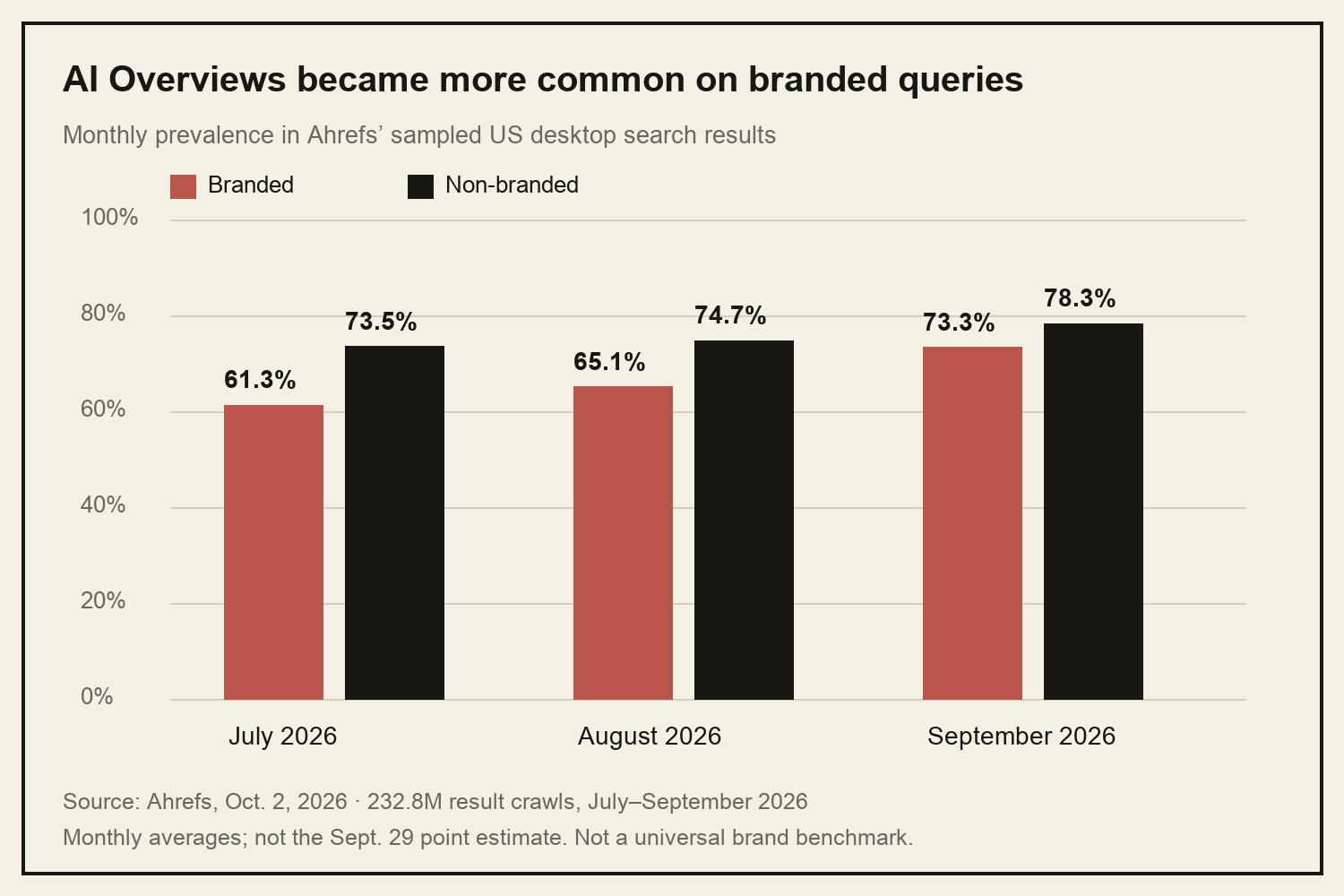
| Month | Branded | Non-branded |
|---|---|---|
| July 2026 | 61.3% | 73.5% |
| August 2026 | 65.1% | 74.7% |
| September 2026 | 73.3% | 78.3% |
That research concerns Google AI Overviews. It does not establish identical behavior in ChatGPT, Gemini, or Perplexity. The practical implication is to inspect the experiences your buyers actually use, rather than assuming your homepage controls the answer.
Step 1: Write down the brand facts an answer should get right
Build a short reference sheet from your current product documentation: company name, product names, category, intended customers, available features, pricing source, geographic availability, and limitations. Give every fact an owner and a link to its authoritative page. Avoid using your positioning statement as proof of an objective claim such as “the best.”
For a software brand, an outdated integration claim can be more damaging than a mildly negative adjective. Prioritize mistakes that could change a purchase decision. Record whether the evidence supports a correction, a clarification, or simply a difference in opinion.
Step 2: Create a small, repeatable question set
| Question type | Example to adapt | What to inspect |
|---|---|---|
| Brand description | What does [brand] do, and who is it for? | Category, audience, feature accuracy |
| Product fit | Is [product] suitable for [specific use case]? | Limitations and unsupported promises |
| Comparison | How does [brand] compare with [competitor] for [need]? | Evidence and meaningful tradeoffs |
| Category discovery | Which tools help [audience] solve [problem]? | Whether your brand appears without being named |
| Trust and recency | What should I verify before choosing [brand]? | Old information and cited sources |
Start with questions sales and support teams actually hear. Include both named-brand and category questions. Our branded versus non-branded visibility guide explains why those groups should have separate denominators.
Step 3: Capture answers without changing the test midstream
For each run, save the exact question, date, platform, displayed model if available, language, location, and whether web search was enabled. Use a fresh conversation to limit carryover from earlier messages. Save the full answer and the visible citation URLs; note when an answer has no citations.
Repeat questions on a consistent cadence and keep the conditions as comparable as possible. Label unavailable models or failed runs rather than counting them as brand absences. Consumer interfaces and APIs may behave differently, so report each separately. This is a monitoring sample, not an estimate of every real customer conversation.
Step 4: Use an audit worksheet that leads to action
| Field | What to record | Action when something is wrong |
|---|---|---|
| Mention | Present or absent; context of mention | Inspect category fit and relevant content gaps |
| Accuracy | Correct, incorrect, or unverified claim | Link the issue to a current authoritative fact |
| Citation | Exact URL and claim it supports | Check age, accessibility, and factual alignment |
| Sentiment | Positive, neutral, negative, or mixed; supporting excerpt | Distinguish real feedback from unsupported generalization |
| Priority | Business impact, owner, next check date | Fix consequential errors before cosmetic wording |
Keep mention rate and citation rate separate. A brand can be named without your website being cited. A page can also be cited without an explicit recommendation. For a reproducible mention rate, divide valid answers mentioning the brand by all valid answers in that fixed group, then show the counts alongside the percentage.
Step 5: Fix the evidence buyers and models can find
Correct inaccurate owned pages first. Put important facts in readable text, link to the relevant product documentation, and remove conflicting descriptions. Where an external citation is outdated, pursue an ordinary correction through that publisher’s process. Updating your website cannot force an AI system to change its answer immediately.
Use the AI content publishing checklist to review new explanations before they go live. Then retest the original questions and inspect whether the answers, sources, and qualified traffic changed. For a broader implementation sequence, follow our 30-day SEO and AEO plan.
Where Seshes.ai fits
Seshes.ai’s brand visibility, citation, and sentiment reporting can help organize monitoring across models and competitors. Use the worksheet above alongside your reports to turn observations into an owned action list. Keep the audit measures separate from product scores unless their definitions match.
Request a Seshes.ai demo and bring five buyer questions, your current brand fact sheet, and the competitors you want to compare.
Frequently asked questions
How often should I run an AI brand visibility audit?
A weekly review is a useful starting cadence for a small fixed question set. Run an additional check after a major product or positioning update, and compare several observations before declaring a trend.
Does a brand mention mean AI sent traffic to my website?
No. A mention shows representation in a sampled answer. Traffic requires a visit, and conversion requires a separate business event. See why visibility and organic traffic can move differently.
Can I guarantee that AI will describe my brand correctly?
No. You can improve the evidence on your pages, identify outdated sources, and monitor changes. The final answer depends on the system, question, context, and available information.
Research checked October 9, 2026. Prepared with AI assistance and checked against the linked sources. The worksheets are Seshes editorial recommendations, not results from a customer experiment.

2 Comments