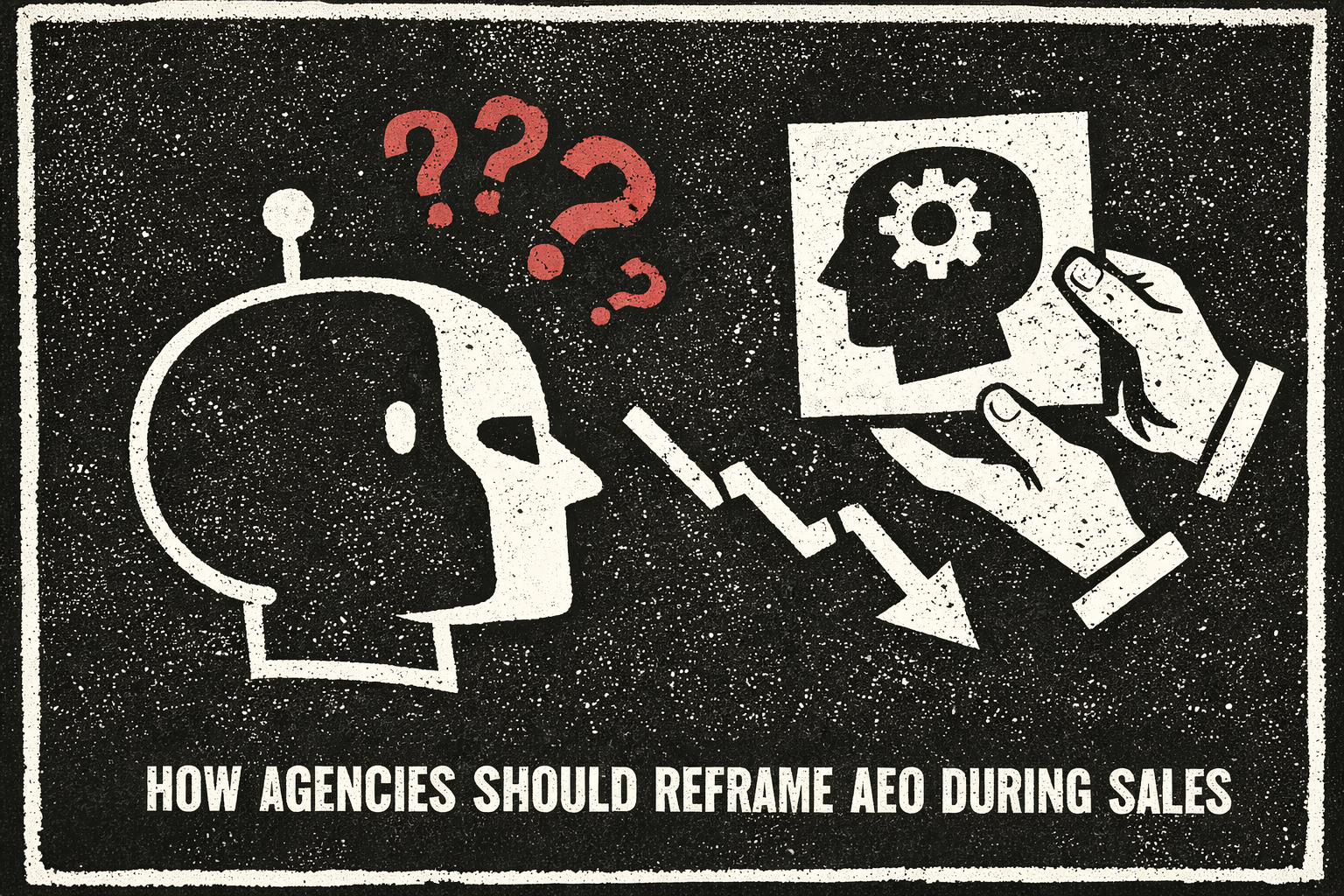
How Agencies Should Reframe AEO During Sales
Most AEO sales conversations break down for one simple reason:
clients are asking for the wrong thing, and agencies keep agreeing.

“We want to rank in ChatGPT.”
“We want to show up more in AI.”
“We want AI traffic.”
Those requests sound reasonable. They’re also the fastest way to mis-sell AEO, set false expectations, and turn a strategic engagement into a reporting headache.
AEO isn’t about rankings, traffic spikes, or visibility in the abstract. It’s about being included correctly, consistently, and favorably when AI systems generate answers.
If agencies don’t reframe this early in the sales process, they inherit impossible KPIs and clients end up disappointed, even when real progress is happening.
This article outlines how to reset the conversation.
The Core Sales Problem: Clients Think in Search Terms
Most clients approach AEO with a mental model shaped by SEO.
They assume:
- AI tools behave like search engines
- Visibility equals rankings
- More exposure equals more traffic
- Progress is linear and immediately measurable
None of those assumptions hold.
AI systems don’t rank pages.
They don’t send predictable referral traffic.
They don’t update uniformly.
And they don’t surface brands simply because they’re “strong.”
AI answers are selective narratives, not result sets.
When clients say “we want to rank in ChatGPT,” what they really mean is:
“We don’t want to be left out of how people are making decisions now.”
That’s a very different problem.
Reframe #1: “We Want to Rank in ChatGPT” → You’re Not in the Conversation
Ranking language is misleading in an AI context.
There is no universal “position #1” in AI answers. Each model:
- Synthesizes responses differently
- Pulls from different sources
- Prioritizes different signals
- Updates on its own timeline
The real risk isn’t ranking lower, it’s not being mentioned at all.
The Correct Frame
AEO is about conversation inclusion, not position.
The first question agencies should ask isn’t:
“Where do you rank?”
It’s:
“Are you being referenced when AI explains your category?”
If the brand isn’t named, recommended, or contextualized inside answers, it doesn’t matter how strong their SEO footprint is. From the user’s perspective, the brand doesn’t exist.
Reframe #2: “We Want to Show Up More” → Visibility Without Control Is a Liability
“Show up more” sounds harmless. It isn’t.
More exposure without narrative control often means:
- Incorrect product descriptions
- Outdated feature claims
- Competitors being framed as better alternatives
- Tone mismatches that damage trust
AI doesn’t just surface brands, it defines them.
The Correct Frame
What brands actually need is consistent brand inclusion, not raw visibility.
That means:
- Being referenced accurately
- Appearing in the right contexts
- Showing up for the right intents
- Being framed in ways that match how the brand wants to be perceived
More mentions ≠ better outcomes if the story is wrong.
Reframe #3: “We Want AI Traffic” → AI Rarely Sends Clean Attribution
AI traffic is a weak primary KPI.
Why?
- Many AI answers never lead to a click
- Attribution is fragmented or invisible
- Influence often happens before search or direct visits
- Brand lift shows up indirectly (conversion rate, brand queries, deal velocity)
Treating AEO like a traffic channel creates friction immediately:
“We’re doing the work—why aren’t sessions going up?”
The Correct Frame
AEO is an influence layer, not a traffic channel.
It shapes:
- Shortlists
- Brand trust
- Product consideration
- Downstream conversion efficiency
Agencies should sell AEO as pre-click positioning, not referral volume.
What Clients Actually Need (But Rarely Ask For)
Once you strip away SEO, era language, most AEO needs collapse into four real requirements.
1. Consistent Brand Inclusion
The brand should appear:
- Across multiple AI models
- Across different prompt phrasings
- Across stages of the buyer journey
One-off mentions don’t matter. Patterns do.
2. Product-Level Accuracy
AI increasingly talks about products, not just brands.
If models are:
- Mixing SKUs
- Misstating features
- Confusing versions
- Recommending competitors’ products instead
That’s a revenue problem, not a visibility problem.
Product clarity matters more than brand authority in many AI contexts.
3. Controlled Narratives
AI answers always tell a story:
- Who is best
- Who is trusted
- Who is modern
- Who is outdated
If the brand isn’t shaping that narrative, the model will do it anyway, using whatever data it finds.
AEO gives agencies leverage over how the brand is described, not just whether it appears.
4. AI Share of Voice (Not Rankings)
In AI systems, competitive advantage looks like:
- Being mentioned more often than competitors
- Being recommended in more contexts
- Owning specific attributes or use cases
This is closer to share of voice than position tracking, and it’s far more defensible in client conversations.
How Agencies Should Position AEO in Sales Calls
If you sell AEO like SEO, you’ll lose trust.
If you sell AEO like narrative control, you’ll win buy-in.
Practical Language That Works
- “Inclusion, not rankings”
- “Consistency across models”
- “Product-level clarity”
- “Narrative alignment”
- “AI share of voice”
Language to Avoid Early
- “Ranking in ChatGPT”
- “Traffic from AI”
- “Page-level optimization”
- “Monthly linear gains”
Those phrases invite the wrong expectations.
Why This Reframe Protects the Agency
Reframing AEO isn’t just about client education, it’s self-defense.
It:
- Prevents impossible KPIs
- Aligns reporting with how AI actually behaves
- Creates space for long-term value
- Positions the agency as strategic, not tactical
Most importantly, it shifts the relationship from:
“What changed this month?”
to:
“Are we becoming harder to ignore?”
That’s the real game.
Final Thought
Clients aren’t wrong to care about AI visibility.
They’re just using outdated language to describe a new problem.
Agencies that succeed with AEO won’t promise rankings or traffic.
They’ll promise presence, accuracy, and narrative control—and then prove it over time.
That’s how AEO should be sold.