The AI Blind Spot: Why Traditional SEO Retainers Break in an AEO World
For years, SEO retainers followed a familiar rhythm: keyword research, content production, link acquisition, monthly reports. Progress was measured in rankings. Movement was expected to be steady. And if nothing moved? The explanation was usually some version of “SEO takes time.”
That mental model collapses the moment AI-generated answers enter the picture.
AEO doesn’t just introduce a new channel, it breaks the assumptions that traditional SEO retainers are built on.
The Core Problem: Deliverables ≠ Outcomes
Most SEO retainers are structured around outputs, not impact.
- X keywords optimized
- Y pages published
- Z backlinks acquired
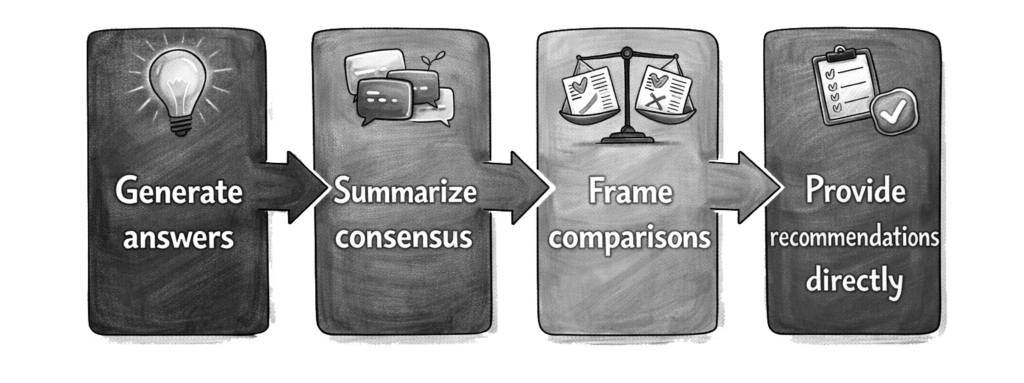
Those deliverables made sense in a retrieval-based system where rankings were the goal and clicks were the reward. But AI answers don’t retrieve pages. They synthesize information.
LLMs don’t care how many keywords you optimized last month. They care whether your brand, product, or perspective is useful to include when forming an answer.
That’s a fundamental mismatch:
- SEO retainers optimize inputs
- AEO requires measuring inclusion
Reporting Without Understanding
Another quiet failure point: traditional reporting.
SEO reports are often dense, technical, and backward-looking:
- Average positions
- Impressions
- Click-through rates
In GEO, those numbers can stay flat while real visibility changes dramatically—or vice versa.
A brand can:
- Lose organic clicks but gain AI mentions
- Rank #1 for a keyword but never appear in AI answers
- Be cited heavily by one model and ignored by another
Reporting that doesn’t explain why an LLM includes or excludes a brand isn’t insight—it’s noise.
The “Nothing Changed This Month” Syndrome
This is where retainers really start to crack.
Clients are conditioned to expect:
- Month-over-month improvements
- Clear causal links between work done and results seen
- Linear progress curves
But AEO doesn’t behave that way.
You can make meaningful improvements to:
- Content structure
- Entity clarity
- Product explanations
- Comparative framing
…and see no visible change for weeks, until suddenly visibility jumps across multiple models at once.
Nothing changed this month is often false. The system just hadn’t crossed its internal thresholds yet.
Linear Expectations in a Non-Linear System
Traditional SEO trained everyone, agencies and clients alike, to think in straight lines.
AEO operates more like compound interest.
- Gains appear unevenly
- Progress stacks invisibly
- One change can unlock multiple downstream effects
This creates tension when retainers are priced, scoped, and justified using linear logic.
Reality Check: How AEO Actually Behaves
If SEO trained us to think in rankings, AEO forces us to think in systems.
LLMs update differently
Models retrain, refresh, and weight sources on different schedules. There is no single “update day.”
Answers shift by model
What works in one model may not translate to another. Visibility is fragmented by design.
Gains show up unevenly
You might dominate product comparisons before ever appearing in category explainers—or the opposite.
AEO progress is cumulative, not incremental
Visibility builds as understanding improves. It’s closer to reputation formation than keyword conquest.
Why This Matters for Retainers
The issue isn’t that retainers are bad. It’s that most were designed for a world that no longer exists.
AEO requires:
- Different success metrics
- Different timelines
- Different conversations with clients
When retainers stay locked to SEO-era expectations, they create friction, confusion, and mistrust—often right when real progress is happening beneath the surface.
The blind spot isn’t execution.
It’s the mental model.
And until that changes, even good AEO work will look broken through an SEO lens.