


The 2026 SEO Shift: From Search Results to AI Answers
The Shift: From Search Results to AI Answers
For most of the last 20 years, discovery followed a predictable loop:
query → search results → click → page.
Search engines retrieved information. Marketers optimized to be retrieved.
Large language models break that loop.
AI systems don’t return lists, they return positions. They synthesize multiple sources, compress context, and decide what deserves to be said at all. That difference sounds subtle, but it completely changes how visibility works.
Search Retrieves. AI Answers Synthesize.
Traditional search is fundamentally a retrieval system.
It ranks documents and lets the user do the interpretation.

AI systems behave differently. They:
- Aggregate multiple sources
- Resolve contradictions
- Compress explanations
- Choose examples
- Decide which brands, products, or concepts are worth naming
In this environment, being indexed is not the same as being included.
A page can rank #1 in Google and still be absent from AI answers—not because it’s “bad,” but because it doesn’t contribute meaningfully to the answer being formed.
Rankings vs Mentions vs Positioning
This is where many teams get stuck.
They ask:
“Where do we rank?”
When the better question is:
“Are we mentioned—and how are we framed?”
In AI answers:
- Rankings are invisible
- Mentions are selective
- Positioning is contextual
If your brand or product isn’t cited, compared, or referenced, you’re effectively not in the conversation—even if your SEO metrics look strong.
This is why AEO doesn’t replace SEO; it exposes its blind spots.
Why “Page 1” Thinking Breaks Down
Page 1 thinking assumes:
- A finite list of results
- User-driven evaluation
- Equal opportunity to compete for clicks
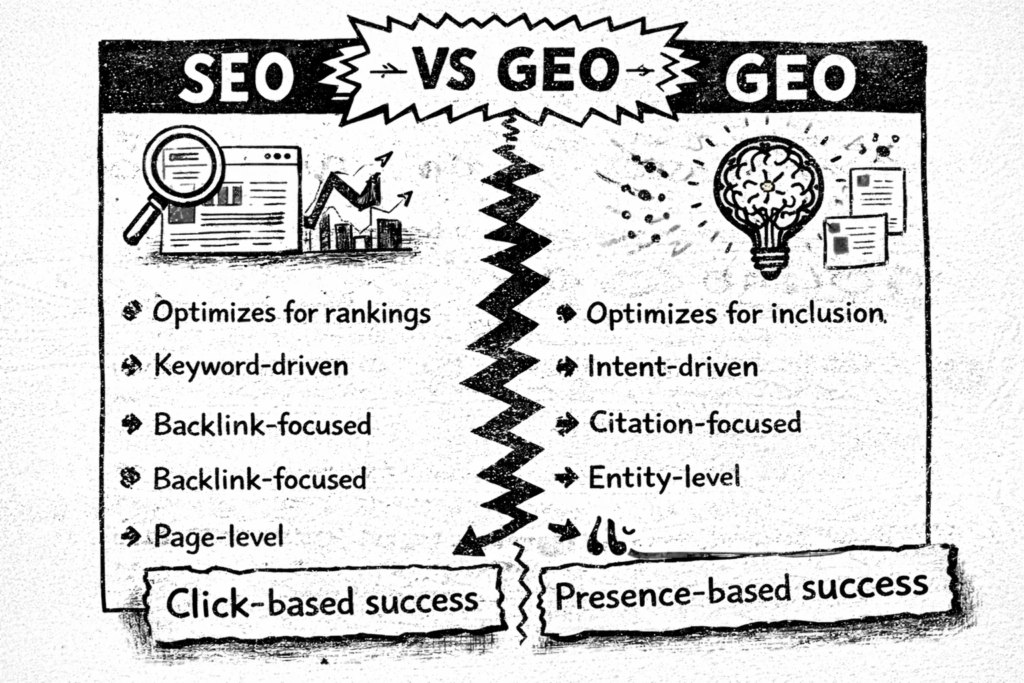
AI answers remove all three.
There is no page 1.
There is only what the model chooses to say.
That choice is influenced by:
- Topic clarity
- Entity consistency
- Product-level specificity
- Coverage depth across related concepts
- Repetition across trusted sources (not backlinks)
If your content doesn’t clearly signal why it should be included in an answer, ranking alone won’t save you.
AI Topics Change the Unit of Optimization
Search trained us to think in pages and keywords.
AI systems think in:
- Topics
- Entities
- Attributes
- Use cases
- Comparisons
That’s why AEO starts to look less like “optimize this page” and more like:
- “Do we own this concept?”
- “Are we the default example?”
- “Do our products show up when this problem is explained?”
This is also why AI insights matter. Without analyzing how models respond to real prompts, it’s easy to optimize for signals that no longer drive inclusion.
Why Brand Visibility ≠ Product Visibility
One of the most common misconceptions in AI optimization is assuming that brand strength automatically carries over to products.
It doesn’t.
LLMs routinely:
- Mention brands without naming products
- Recommend products without emphasizing the parent brand
- Split brand and product authority across different answers
A brand can be “known,” while its flagship product is invisible.
A product can dominate answers while the brand fades into the background.
AEO forces teams to track—and optimize—both independently.
From Retrieval to Inclusion
This is the core distinction:
- SEO optimizes for retrieval
- AEO optimizes for inclusion
Inclusion means:
- Being referenced when answers are generated
- Being positioned correctly when alternatives are compared
- Being consistently named across models, prompts, and contexts
If SEO taught us how to get found, AEO teaches us how to be chosen.
And in an AI-driven discovery layer, being chosen is what determines whether you show up at all.


2 Comments